

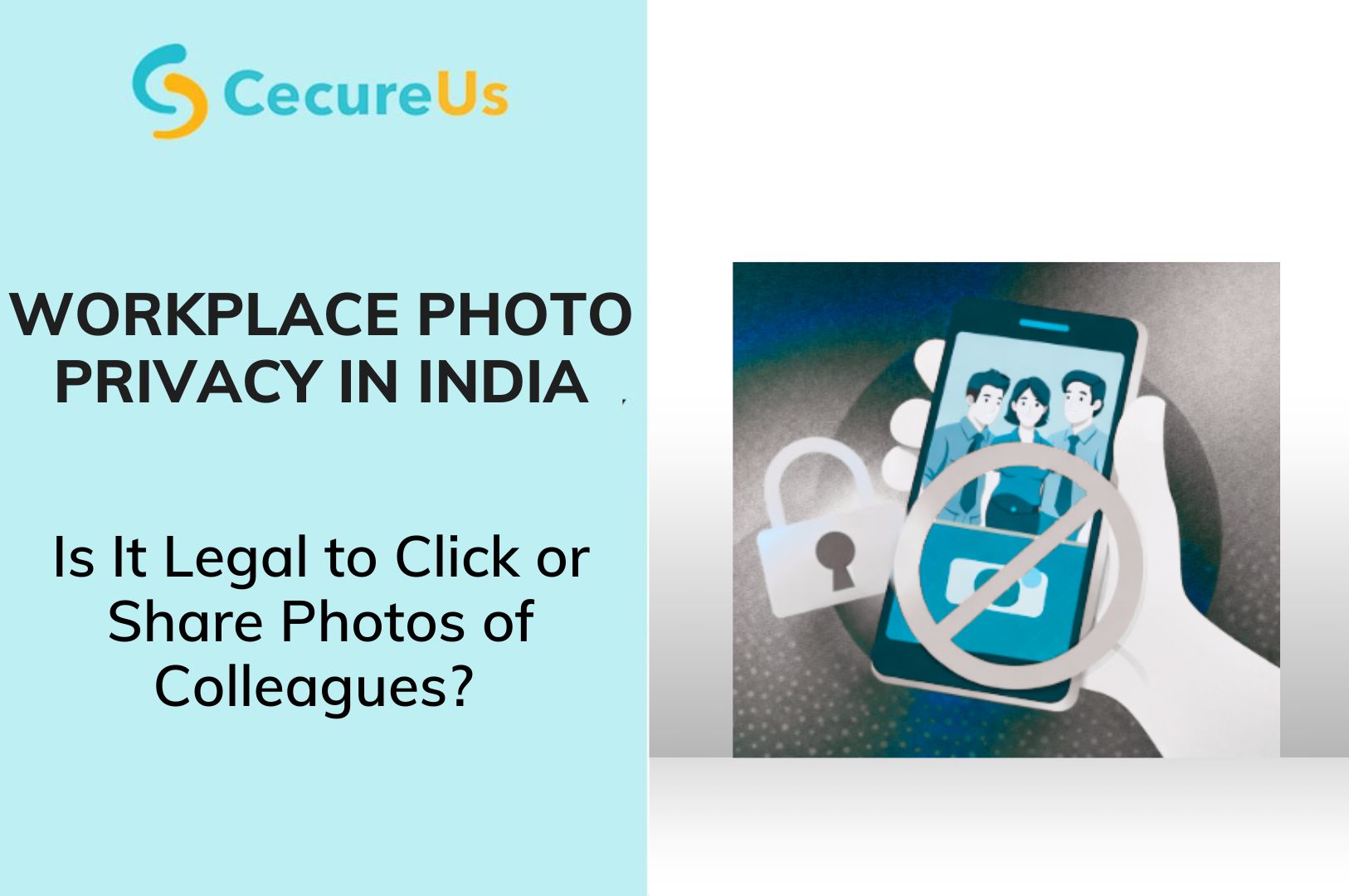
31 Dec Workplace Photo Privacy in India: Is It Legal to Click or Share Photos of Colleagues?
In modern workplaces, photography has become routine. Team-building events, celebrations, offsites, and even casual days at work often lead to employees clicking pictures of one another. But Indian law has become significantly stricter about photo privacy, especially after the Digital Personal Data Protection Act (DPDP Act) 2023.
This raises two critical workplace questions:
- Is it legally permissible to take photographs of colleagues at work?
- Is it permissible to post or share those photographs on social media or messaging platforms?
Legally, both actions require clear, voluntary, informed consent, and failing to comply can lead to serious civil and criminal consequences.
Why Photo Privacy Matters in the Workplace
Workplaces are not public spaces; they are professional environments where employees have a reasonable expectation of privacy. A simple photo, when shared without consent, can lead to:
- Mental distress
- Workplace harassment
- Damage to professional reputation
- Misuse on digital platforms
- Legal liability for individuals and organisations
With stricter laws under the DPDP Act, organisations must treat photographs as personal data and ensure responsible handling.
- Is It Legal to Take Pictures of Colleagues at Work?
Not without consent.
Under the DPDP Act 2023, photographs qualify as personal data. Capturing a person’s image without clear consent is considered unauthorised data processing.
In a workplace setting, this means:
- Clicking candid images of colleagues without informing them is not permitted.
- Photographing employees during events requires upfront disclosure.
- Consent must be voluntary, specific, and documented wherever possible.
Repeatedly photographing a colleague after they object can also be considered:
- Harassment
- Stalking under IPC Section 354D
- Violation of the constitutional right to privacy
- Is It Legal to Share or Post Workplace Photos of Colleagues?
No. Sharing requires explicit, informed consent.
This includes sharing photos on:
- WhatsApp groups
- Company social media pages
- Internal newsletters
- Websites, brochures, and promotional material
Once a photo is published, the legal responsibility increases because it becomes data dissemination and may trigger various provisions of the DPDP Act, IT Act, and IPC.
Even if someone permitted you to take their picture, that does not mean they consent to publication. This distinction has been repeatedly reaffirmed by Indian courts.



Legal Framework Governing Workplace Photography in India
- Digital Personal Data Protection Act (DPDP Act) 2023
The DPDP Act treats photos and videos as personal data. Any individual or organisation that collects, stores, or shares images becomes a Data Fiduciary and must:
- Obtain explicit consent
- Limit use to the stated purpose
- Ensure safe storage and processing
- Delete data upon request
- Notify individuals of their rights
Violations can result in:
- Investigations by the Data Protection Board
- Heavy monetary penalties
- Reputational and compliance consequences
- Information Technology Act, 2000
Section 66E – Privacy Violation
Criminalises capturing, publishing, or transmitting images of private body parts without consent.
Punishment: Up to 3 years imprisonment or fine up to Rs. 2 lakh, or both.
Sections 67 and 67A – Obscene and Sexually Explicit Content
Criminalise publication or transmission of sexually explicit or obscene images.
Punishments range from 3 to 5 years imprisonment and significant fines.
- Indian Penal Code (IPC)
Section 354C – Voyeurism
Watching, capturing, or sharing private moments without consent.
Punishment: 1 to 3 years for first offence; higher for repeat offences.
Section 509 – Outraging the Modesty of a Woman
Posting a woman’s photograph without consent, in a way that causes insult or harassment.
Punishment: Up to 3 years imprisonment and fine.
Section 500 – Defamation
Sharing images that damage someone’s reputation.
Punishment: Up to 2 years imprisonment and/or fine.
- Article 21 of the Indian Constitution – Right to Privacy
The Puttaswamy Judgment (2017) firmly established privacy as a fundamental right.
Unauthorised photography or sharing of images in a workplace environment can qualify as a violation of Article 21, enabling individuals to approach High Courts or the Supreme Court.
Workplace Scenarios: What is Allowed and What is Not?
Scenario 1: Group Photo at a Team Lunch
Permitted only if all individuals have given consent to be photographed.
Scenario 2: Posting Team Outing Pictures on LinkedIn
Requires prior consent from every person visible in the image.
Scenario 3: Photographing a Colleague Without Their Knowledge
Not permitted. Violates DPDP Act and privacy rights.
Scenario 4: Sharing Photos on Messaging Apps Without Checking
Illegal if recipients did not consent.
Could trigger IPC 509, IPC 500, or even IT Act sections depending on misuse.
Scenario 5: Company Using Employee Photos in Recruitment or Marketing Collateral
Requires separate written consent, distinct from routine HR or joining documentation.
Scenario 6: Employee Repeatedly Taking Photos After Requests to Stop
Considered harassment or stalking under IPC 354D.
Relevant Case Laws Strengthening Photo Privacy
- Puttaswamy vs Union of India (2017)
The Supreme Court held that privacy is intrinsic to Article 21. Any unauthorised photography can violate this right.
- Cases Under Section 66E (IT Act)
Courts have ruled that photographing or circulating images without consent, even outside traditionally private spaces, violates privacy.
- Judicial Interpretation of Consent
Several High Courts have emphasised that:
Consent to being photographed is not equal to consent to publication.
This is critical for workplaces that use photos for branding or social media.
What Offences Can Non-Consensual Workplace Photography Lead To?
| Action | Potential Offence | Applicable Law | Punishment |
| Capturing photos without consent | Privacy violation, unlawful data processing | DPDP Act, Article 21 | Monetary penalty, legal remedies |
| Sharing/posting photos without permission | Voyeurism, harassment, data misuse | IPC 354C, IPC 509, DPDP Act | 1–3 years imprisonment, fine |
| Sharing images that harm reputation | Defamation | IPC 500 | Up to 2 years imprisonment |
| Capture or circulation of private images | Violation of modesty, IT Act offence | IT Act 66E, IPC 354C | Up to 3 years imprisonment |
| Publishing obscene content | IT Act offence | Sections 67, 67A | 3–5 years imprisonment |
What Should Employees and Organisations Do?
For Employees
- Always seek permission before taking photos.
- Never post workplace images without explicit approval.
- Respect colleagues who prefer not to be photographed.
For Organisations
- Include a Photo and Video Policy in the Code of Conduct.
- Use DPDP-compliant consent forms for events, training sessions, and marketing use.
- Display notices when photography or videography will occur.
- Train employees on digital hygiene and workplace privacy.
- Provide clear channels for grievances related to photo misuse.
What to Do If Your Photo Privacy Is Violated
- Request immediate takedown from the individual or platform.
- Escalate to HR or the Internal Committee (if harassment is involved).
- File a complaint under DPDP Act with the Data Protection Board.
- Approach Cyber Crime Cell under IT Act provisions.
- Seek constitutional remedy through the High Court for Article 21 violations.
Conclusion: Photo Privacy Is a Legal and Ethical Responsibility in Workplaces
Workplace photography must be governed by consent, transparency, and respect. With the DPDP Act 2023, Indian law has made it clear that employees have the right to control their images, and misuse—intentional or accidental—can lead to serious legal consequences.
In high-trust workplaces, respecting photo privacy is essential not only for compliance but for building a safe, inclusive, and psychologically secure culture.