

08 Jul Dr. Sohail Malik v. Union of India, Dec 2025: Can a PoSH Complaint Be Heard by the Complainant’s Workplace IC When the Respondent Works Elsewhere?
One of the most common questions in PoSH compliance is:
“If the complainant and respondent belong to two different organisations, which Internal Committee should conduct the inquiry?”
This question became especially important after the Supreme Court’s judgment in Dr. Sohail Malik v. Union of India, where the Court clarified the jurisdiction of the Internal Committee under the Sexual Harassment of Women at Workplace (Prevention, Prohibition and Redressal) Act, 2013.
The judgment is highly relevant for organisations that work with vendors, contractors, consultants, clients, group companies, government departments, third-party employees, and employees working across shared workplace environments.
Background of the Case
In Dr. Sohail Malik v. Union of India, the issue before the Supreme Court was whether the Internal Complaints Committee constituted at the workplace of the aggrieved woman could inquire into a complaint of sexual harassment against a respondent who was employed in a different department or workplace.
The respondent argued that the complaint should be handled by the IC/ICC of his own workplace. The Supreme Court rejected this narrow interpretation.
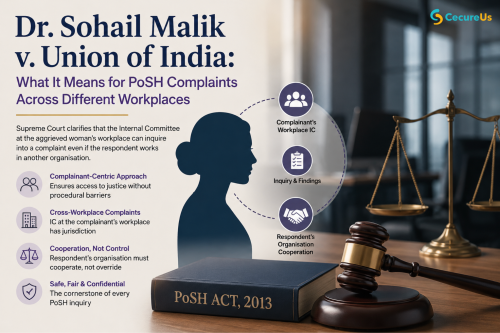
The Court held that the Internal Committee at the aggrieved woman’s workplace is competent to receive and inquire into the complaint, even if the respondent is employed elsewhere. The Court clarified that the PoSH Act is a protective and remedial legislation, and its interpretation must prioritise the aggrieved woman’s access to a safe, familiar and accessible redressal mechanism.
Key Legal Principle from the Judgment
The Supreme Court examined the definition of “respondent” under Section 2(m) of the PoSH Act. The Act defines respondent as “a person against whom the aggrieved woman has made a complaint under Section 9.”
The Court observed that the use of the expression “a person” is significant. It does not restrict the respondent to being an employee, co-worker, colleague, or someone working in the same organisation as the aggrieved woman. Once a complaint is made before a validly constituted IC, the person complained against becomes the respondent for the purposes of the PoSH Act.
Why This Judgment Matters
Before this judgment, many organisations were unsure whether an IC could inquire into a complaint when the respondent belonged to another employer.
This judgment clarifies that the PoSH Act is complainant-centric, not employer-centric.
The Court recognised that asking an aggrieved woman to approach the respondent’s workplace IC may create procedural, logistical and psychological barriers. It may also force her to pursue justice in an unfamiliar workplace where she has no institutional comfort or support. The Supreme Court therefore held that such an interpretation would defeat the purpose of the PoSH Act.
Practical Impact for Employers
This judgment has practical implications for all organisations.
If a woman employee files a PoSH complaint against a person working in another organisation, vendor company, client company, group company, contractor organisation or different department, her own workplace IC can take up the complaint.
However, the respondent’s employer must cooperate with the inquiry by facilitating participation, sharing relevant records, supporting witness availability and acting on the final findings or recommendations as per applicable service rules.
Can the Respondent’s Organisation Refuse to Cooperate?
No. The respondent’s organisation should not refuse cooperation merely because its IC is not conducting the inquiry.
The respondent’s employer may be required to provide:
- Respondent’s employment details
- Official contact details
- Reporting manager details
- Work location details
- Relevant documents
- Attendance or duty records
- CCTV or access logs, where relevant
- Witness coordination
- Support for implementing recommendations
The respondent’s employer should act as a facilitator and cooperating employer, not as a parallel inquiry authority.
What If the Complainant Willingly Files the Complaint in the Respondent’s Organisation?
This is a practical question many ICs are now asking.
The judgment does not say that a complainant is prohibited from approaching the respondent’s organisation. However, the important point is that she cannot be compelled to do so.
If the complainant voluntarily files the complaint before the respondent’s organisation IC, the respondent organisation should carefully document that the complaint was filed willingly and without pressure.
Before proceeding, the IC should check:
| Question | Why It Matters |
| Did the complainant approach the respondent organisation voluntarily? | To ensure she was not redirected or pressured. |
| Is she comfortable participating in that inquiry? | The process should not create emotional or logistical barriers. |
| Is there a clear workplace connection? | PoSH applies when there is a workplace nexus. |
| Can confidentiality and neutrality be ensured? | Especially when she is not an employee of that organisation. |
| Should her own employer or IC be informed? | Coordination may be required for support, evidence or interim relief. |
The safer approach is to allow the aggrieved woman to access the IC of her own workplace. If she still chooses another forum voluntarily, the reasons and consent should be clearly recorded.
Can There Be a Joint Inquiry by IC Members from Both Workplaces?
This is another frequently asked question after the judgment.
There is no clear provision in the PoSH Act that allows two separate employers’ ICs to merge and form one joint inquiry committee for a specific complaint.
At the same time, there appears to be no direct reported case law that says a joint inquiry committee is illegal per se.
However, a joint inquiry may create legal and procedural risks, including:
- Confusion over which IC has jurisdiction
- Questions about whether the IC composition is valid under Section 4
- Risk of confidentiality breach
- Risk of the respondent later challenging the inquiry
- Blurring of responsibility for findings and recommendations
- Uncertainty over who signs the final report
- Confusion over who implements disciplinary action
The safer position after Dr. Sohail Malik v. Union of India is:
The IC of the aggrieved woman’s workplace should conduct and own the inquiry. The respondent’s employer should extend full cooperation and may nominate a SPOC, HR representative or IC member only for coordination support, not as a member of the inquiry panel.
Can the Respondent Organisation’s IC Members Attend the Inquiry?
They may support the process, but they should not ordinarily participate as inquiry panel members.
They can assist with:
- Coordinating the respondent’s availability
- Facilitating witness availability
- Preserving and sharing records
- Coordinating CCTV or access log review
- Providing employment details
- Supporting communication between organisations
- Implementing final recommendations
They should avoid:
- Questioning the complainant
- Cross-examining witnesses
- Sitting in IC deliberations
- Influencing the findings
- Signing the complainant IC’s inquiry report
- Conducting a parallel inquiry into the same complaint
A good way to describe their role is:
“Coordination support without interfering with the independent functioning of the complainant workplace IC.”
How Will the Respondent Organisation Know What Evidence to Share?
The respondent organisation does not need to be part of the inquiry panel to support evidence collection.
It can ask the complainant’s IC for limited particulars such as:
- Date of the alleged incident
- Approximate time
- Location
- Broad substance of the allegation
- Specific records required
- Relevant CCTV location or time window
- Witnesses whose availability is required
- Any documents needed from the respondent’s employer
This is not interference. It is necessary for meaningful cooperation.
The respondent’s organisation should preserve relevant material immediately and share evidence only on written request, on a need-to-know basis, while maintaining confidentiality.
Who Takes Action Against the Respondent?
This is an important distinction.
The complainant workplace IC may conduct the fact-finding inquiry and give findings/recommendations. However, if the respondent is employed elsewhere, the respondent’s employer will generally implement disciplinary action based on the findings, in accordance with applicable service rules or employment policies.
The Supreme Court recognised this distinction between the power to inquire and the power to impose disciplinary consequences.
FAQs on Cross-Workplace PoSH Complaints
- Can the complainant’s workplace IC inquire into a respondent from another organisation?
Yes. The Supreme Court has clarified that the IC at the aggrieved woman’s workplace can inquire into the complaint even if the respondent is employed elsewhere.
- Does the respondent have to be an employee of the same organisation?
No. Section 2(m) of the PoSH Act defines respondent as “a person” against whom the aggrieved woman has made a complaint. The definition is not limited to an employee of the same organisation.
- Can the respondent’s organisation IC insist on conducting the inquiry?
Not merely because the respondent is its employee. After this judgment, the complainant’s workplace IC has jurisdiction when the aggrieved woman files the complaint there.
- Can the complainant file the complaint with the respondent’s organisation voluntarily?
Yes, she may do so voluntarily. But she cannot be forced to approach the respondent’s workplace IC. If she voluntarily chooses that route, the respondent organisation should document her consent and ensure that the process remains safe, neutral and accessible.
- Can two ICs conduct a joint inquiry?
A joint inquiry is not expressly prohibited, but it is not the safest model. The PoSH Act does not clearly provide for a merged IC across two employers. The better approach is that the complainant’s workplace IC conducts the inquiry, while the respondent’s employer provides cooperation and coordination support.
- Can respondent-side IC members participate in the inquiry?
They may support coordination, but they should not ordinarily participate as inquiry panel members. Their role should be limited to facilitating respondent participation, witness availability, evidence preservation and implementation of recommendations.
- Can the respondent’s employer ask for the complaint copy?
The respondent should receive the complaint or substance of allegations and relevant supporting documents to enable a proper response. The employer may request limited details or a redacted summary only to provide administrative support, preserve evidence, coordinate witnesses or take necessary action, while maintaining confidentiality.
- Can the respondent’s employer refuse to share CCTV or witness details?
The respondent’s employer should not refuse reasonable cooperation. However, it can ask the complainant’s IC to specify the date, time, location, camera angle, witness relevance or document requirement before sharing records.
- Can the respondent’s employer conduct a parallel inquiry?
A parallel inquiry into the same PoSH complaint is not advisable. It can create confusion, duplication and procedural conflict. The respondent’s employer may conduct internal administrative steps only to preserve records, ensure cooperation and implement final action.
- Who will impose punishment if the complaint is proved?
The complainant’s workplace IC may give findings and recommendations. The respondent’s employer will usually implement disciplinary action against its employee in accordance with service rules, employment contract and internal policies.
Best Practices for Organisations
For the complainant’s employer:
- Allow the aggrieved woman to access her own IC.
- Conduct the inquiry independently and confidentially.
- Share necessary notices and documents with the respondent.
- Seek cooperation from the respondent’s employer in writing.
- Maintain clear records of all evidence requests.
- Send findings/recommendations to the respondent’s employer for action where required.
For the respondent’s employer:
- Acknowledge the complainant IC’s jurisdiction.
- Nominate a single point of contact.
- Preserve relevant evidence immediately.
- Facilitate respondent and witness participation.
- Share documents only on written request.
- Avoid conducting a parallel inquiry.
- Maintain strict confidentiality.
- Act on the final report as per service rules.
Suggested Wording for Respondent Employer
If your organisation receives a communication from the complainant’s IC, you may respond as follows:
“We acknowledge the jurisdiction of the Internal Committee constituted at the aggrieved woman’s workplace to examine the complaint in accordance with the PoSH Act and the principles laid down in Dr. Sohail Malik v. Union of India. We assure full cooperation in facilitating the inquiry process, including sharing relevant employee details, facilitating the respondent’s participation, preserving and providing relevant records, and coordinating witness availability as may be reasonably required by the Committee. Our representatives will support coordination without interfering with the independent functioning of the Committee.”
Conclusion
The judgment in Dr. Sohail Malik v. Union of India is a significant development in PoSH law. It reinforces that the PoSH Act must be interpreted in a manner that supports the aggrieved woman’s access to justice and does not create unnecessary barriers based on organisational boundaries.
For cross-workplace complaints, the best practice is clear:
The complainant’s workplace IC should lead the inquiry. The respondent’s employer should cooperate fully. A joint inquiry may appear collaborative, but it can create avoidable legal and procedural risks.
Organisations must therefore build clear SOPs for cross-organisation PoSH complaints, evidence sharing, confidentiality, respondent participation and implementation of recommendations.