

30 Apr New Labour Code 2025: Impact on PoSH Compliance – What HR and IC Members Must Know
New Labour Code 2025: A Shift HR Cannot Ignore
India’s New Labour Codes mark a decisive shift in workplace regulation. Multiple labour laws have now been brought under a unified framework to simplify compliance and strengthen employee protection.
These Codes apply across industries and cover all categories of workers. This includes employees, contract staff, consultants, gig workers, and platform workers.
While the POSH Act, 2013 continues to govern sexual harassment, the environment in which it operates has changed.
For HR teams and Internal Committees, this means one thing.
PoSH can no longer function as a standalone policy. It must align with wage laws, grievance systems, and workplace safety requirements.
This is where many organizations will either evolve or fall behind.
Why This Matters for HR Leaders and IC Members
The New Labour Codes bring a fundamental shift.
From policy based compliance to system based accountability.
This means
Your PoSH decisions now have financial and legal implications
Your documentation can be reviewed across multiple laws
Your coverage must extend beyond traditional employees
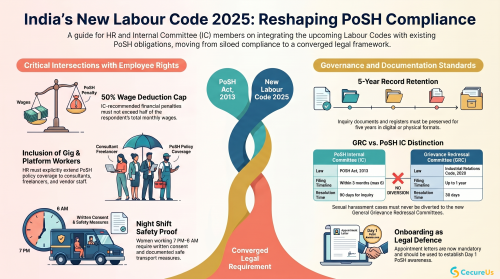
1. PoSH Financial Penalties Must Align with Wage Laws
Under the Code on Wages, 2019, IC recommendations involving financial penalties must follow strict rules.
What HR must ensure
Total deductions including PF, tax, and fines do not exceed 50 percent of wages The respondent is given a fair opportunity to be heard The penalty is recorded in the Register of Fines and Deductions
What this means
A legally sound PoSH inquiry can still fail if execution violates wage law.
Insight for HR Your role does not end with the IC report. It extends to legally compliant implementation.
2. Gig and Platform Workers: Expanding the Scope of PoSH
The Code on Social Security, 2020 formally recognizes gig and platform workers.
Compliance gap to address
Most organizations still have employee only PoSH policies.
What HR must do
Extend PoSH coverage to consultants, freelancers, vendor employees, and gig workers Ensure reporting mechanisms are accessible to them
Reality check If they are part of your workplace ecosystem, they are part of your responsibility.
3. GRC vs PoSH IC: A Critical Distinction
With the Industrial Relations Code, 2020, organizations must also set up a Grievance Redressal Committee.
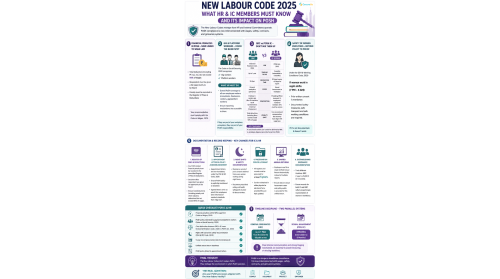
Key differences HR must understand
GRC handles general workplace grievances PoSH IC handles sexual harassment complaints
GRC allows complaints up to one year PoSH follows a shorter timeline of three to six months
GRC resolves within thirty days PoSH inquiries may take up to ninety days
Risk area
Misrouting complaints Delays in action Legal non compliance
Important A sexual harassment case cannot be handled by GRC A workplace dispute cannot be forced into PoSH
4. Safety of Women Employees: From Policy to Proof
Under the Occupational Safety, Health and Working Conditions Code, employing women in night shifts requires compliance.
Mandatory requirements
Prior written consent Documented safety measures Safe transport and working conditions
Why this matters for PoSH
In cases arising during late hours, documentation becomes your strongest defence.
Key principle If it is not documented, it does not exist.
5. Documentation Is Now Your Legal Defence
The New Labour Codes reduce complexity but increase accountability.
What has changed
Registers reduced from eighty four to eight Mandatory five year record retention Records can be maintained in electronic format Unified annual return replaces multiple filings
For PoSH compliance
Financial penalties must be formally recorded Inquiry must show due process followed Data must align with annual reporting
Shift for HR and IC Documentation is no longer administrative. It is legal evidence.
6. Appointment Letters: Your First Compliance Tool
The Codes mandate issuing appointment letters to all employees.
Strategic opportunity for HR
Attach PoSH policy Define expected conduct Establish awareness from day one
This is not onboarding. This is proactive risk management.
7. Managing Dual Timelines: A New HR Challenge
HR teams must now manage two parallel timelines.
PoSH complaints within three to six months General grievances up to one year
Risks – Employees missing reporting timelines Complaints being misclassified
Solution – Clear communication Strong triaging systems Prepared HR response
Insight The first response determines compliance.
From Compliance to Convergence
The New Labour Codes do not replace PoSH. They reshape how PoSH operates.
PoSH is now interconnected with wages, safety, contracts, and grievance systems.
Organizations that fail to align will face Implementation gaps Legal exposure Loss of employee trust
Quick Checklist for HR and IC
Financial penalties within fifty percent wage limit PoSH policy extended to gig and contract workers Clear distinction between GRC and PoSH IC cases Night shift consent and safety documentation Five year record preservation Unified annual return readiness PoSH policy linked to appointment letters
Closing Insight
No complaints is not a measure of compliance. Policy in place is not a measure of readiness.
The real question is “Are your PoSH processes aligned with the new labour reality?”
If your organization is still treating PoSH as a standalone compliance, it is time to rethink.
At CecureUs, we help organizations move from compliance to culture by aligning PoSH with the new labour framework.
Reach out to build a workplace that is not just compliant, but trusted.